Record Club Wants to Do for Music What Letterboxd Did for Film
Record Club is a free social tracking platform for music listeners, drawing clear comparisons to Letterboxd. Here's how it holds up.
A Social Layer That Music Has Been Missing
Film has Letterboxd. TV has Binge. Music, for a long time, had nothing quite like either - just scattered streaming stats, a few spreadsheets, and Last.fm doing its quiet, underappreciated thing in the background. Record Club launched a couple of years ago and has been steadily building an audience among people who want more than a year-end Spotify Wrapped to show for their listening habits. It’s not a streaming service. It doesn’t play music. What it does is give you a place to log what you’re hearing, rate it, write about it, and see what other people with actual taste are doing.
After a few days with the platform, the Letterboxd comparison holds - not perfectly, but enough to matter.
The interface is clean in a way that earns the word. White space is used deliberately, text is bold and legible, and the overall structure doesn’t require a tutorial to navigate. Though Record Club does offer one anyway when you first sign up - a brief walkthrough of the key features that gets you oriented without overstaying its welcome.
What the Platform Actually Does
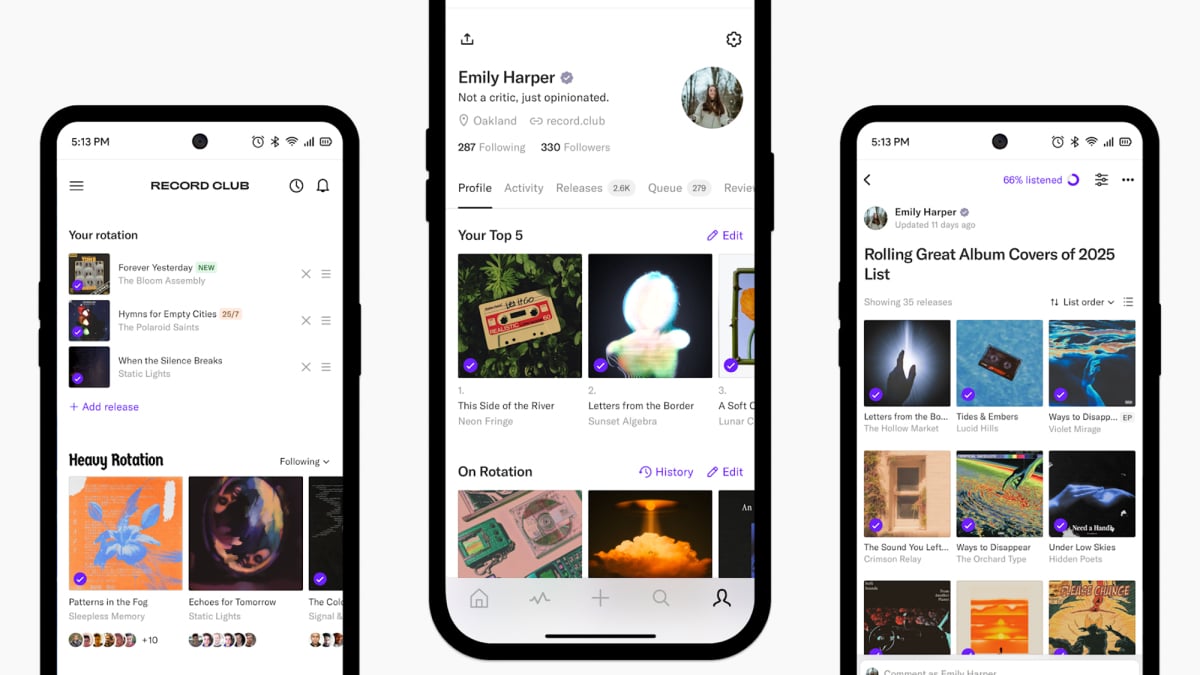
The core of Record Club is logging. When you land on your home screen, one of the first things you see is a section called Your rotation, where you can add whatever you’re currently listening to. The limit is five albums, singles, or EPs at any one time. Add a sixth, and something already in your rotation has to leave. It’s a small design choice that forces a kind of intentionality - you can’t just dump your entire library in there and call it active listening.
Finding music to add is fast. Type an artist name or album title, and results appear quickly. The database appears comprehensive enough that you’re unlikely to hit walls with anything released through a major label or well-documented indie catalog.
Each album page pulls together a meaningful amount of information in one place: the track listing, original release date, total running time, average rating across the Record Club network, number of listeners, and any reviews left by other users. It’s genuinely useful at a glance. Click on another user’s profile and you get a clear picture of their listening life - what they’re currently spinning, their top five records, their written reviews, and which upcoming releases they’ve flagged as ones to watch.
Navigation, Privacy, and Import Options
The web interface organizes everything under three main headers: Browse for discovering new and upcoming music, Community for watching what other listeners are doing, and Activity for your own listening history. Mobile works the same way, and the layout carries over without the usual awkwardness of a desktop-first design trying to adapt.
Your profile is public by default, but that’s adjustable. Going to Settings > Profile and then switching to Privacy lets you control what’s visible - or make the whole profile private, accessible only to people who already know your username. The Preferences tab handles some of the platform’s behavioral settings.
The import situation is worth noting specifically. Record Club currently supports bringing in listening history from Rate Your Music and Last.fm. Spotify imports are listed as coming soon. If you’ve been using Last.fm for years - and there’s a reasonable argument for doing so - the ability to pull that data in means you don’t start from zero. Your listening history can also be exported at any time, which matters more than it might seem. Platforms come and go, and having your data locked inside one is a real cost that Record Club has apparently thought about.
Pricing and What the Subscription Gets You
Record Club is free, and the free tier is functional rather than crippled. There are no ads.
The $4-per-month subscription is framed as supporting the project rather than unlocking features you’d feel penalized without. That said, paying does get you tangible extras: better list management tools, the ability to choose preferred cover art for albums in your library, extensive personalized listening statistics, and the option to attach personal notes to individual releases.
That last one - notes on releases - is the kind of feature that sounds minor until you want it. Being able to record why a particular album mattered at a particular time, without that context living only in your memory or a separate document, is genuinely useful for anyone who thinks about music as more than background noise.
Where the Letterboxd Comparison Works and Where It Strains
Letterboxd built its reputation on a combination of solid tracking tools and a social culture that developed organically around them. The lists, the reviews, the following relationships - those emerged from a community that formed around people who cared deeply about film. Record Club has the same structural ambitions.
The tracking side is already there. The social layer is growing, but it’s thinner than Letterboxd’s at this point - which is simply a function of age and user base, not a design failure. The comparison becomes most accurate once you start using the community features rather than just logging albums. Following other users, reading their reviews, seeing their rotations - that’s where the platform starts to feel like something rather than just a database with a nice coat of paint.
One practical difference between music and film also shapes what Record Club can be: albums get revisited constantly in a way that individual films often don’t. A Letterboxd diary entry for a film usually marks a discrete event. On Record Club, logging an album you’ve listened to dozens of times over ten years requires a different kind of framing. The platform accommodates this, but it’s worth going in with calibrated expectations about what “logging” means in a music context versus a film one.
Getting Started Without Overthinking It
The onboarding is low-friction. Sign up, take the quick tour, add a few albums to your rotation, follow a couple of suggested users, and you have enough of a setup to understand what the platform is doing. The suggestions for who to follow are useful early on - they give the community features something to work with before you’ve built your own network.
Bringing in Last.fm data is worth doing immediately if you have it, since it populates your history and makes the stats more interesting. Rate Your Music data can come in the same way. The Spotify import, once it arrives, will lower the barrier further for people whose listening history lives entirely inside that ecosystem.
Whether Record Club reaches the cultural footprint that Letterboxd has built is an open question that depends on factors beyond the platform itself - music’s listening culture is noisier, more fragmented, and less oriented around discrete events than film-watching. But as a tool for the kind of listener who already thinks carefully about what they’re hearing, the free tier alone is worth the twenty minutes it takes to set up.
The $4 monthly subscription, for what it adds, is one of the less aggressive pricing asks in this category.